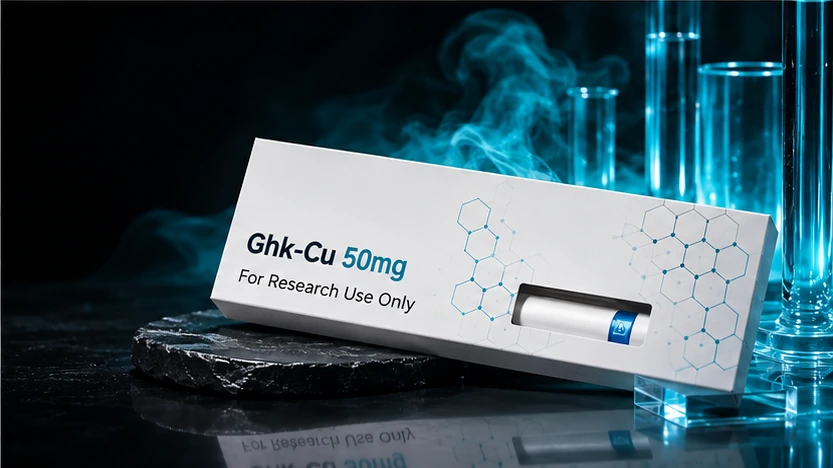
What is GHK-Cu?
GHK is the tripeptide glycyl-L-histidyl-L-lysine. It can coordinate copper ions, producing the complex commonly referred to as GHK-Cu or copper tripeptide-1 in some contexts.
Researchers study the complex because peptide-metal interactions can influence biochemical behaviour and because GHK-Cu has appeared in a range of cell, tissue and molecular research literature.
Why does copper binding matter?
Copper is an essential trace element and participates in numerous enzymes and redox processes. Binding a copper ion changes the chemical context of the peptide, which is why GHK and GHK-Cu should not simply be treated as interchangeable labels in technical discussion.
What areas are investigated?
Published work has explored GHK-Cu in relation to extracellular-matrix processes, cellular signalling, gene-expression patterns and experimental models involving tissue biology. The strength and relevance of evidence varies substantially by model.
How to read GHK-Cu research
Check whether a paper studies GHK, GHK-Cu, a formulated cosmetic ingredient or another copper-peptide complex. Also note concentration, model, endpoint and whether the work is in vitro, animal or human research. These details determine what conclusions a study can support.
Peptrion catalogue context
Peptrion lists GHK-Cu as a research material. The product page describes the labelled presentation and available documentation. That catalogue record should not be interpreted as approval for clinical, cosmetic or veterinary administration.